This checklist applies to buy-side marketing due diligence engagements, typically on transactions ranging from £10m to £200m, for private equity or debt providers. Scope is usually two to four weeks from engagement letter to submitted report. It adapts for post-close portfolio audits where the same questions apply but the timeline is less compressed.
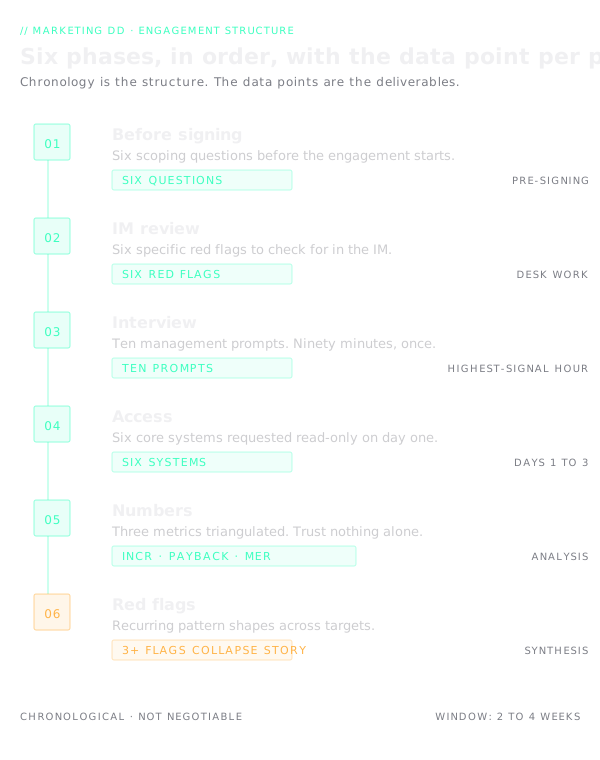
What follows is the order I wish I'd worked through it the first few times. The numbered sections reflect how the work tends to stack up, not the sequence you read in a textbook. Read them in order; expect to revisit each of them at least twice before report submission.
Written for UK and EU deal contexts under FCA-aligned disclosure norms. US transactions follow different data room conventions and target-company consent regimes; most of the method transfers but the specific documents and access patterns will differ.
Before the engagement
Most of the mistakes I've seen in marketing DD, my own included, trace back to questions not asked during the scoping call. None of them are technical. All of them shape how much useful work you can actually do inside the window.
Before you sign, get answers to the following:
| Question | Why it matters |
|---|---|
| What's the deal structure? | Debt vs equity shifts what counts as evidence. Debt providers care about repayment risk; equity cares about upside. |
| Who's the management team? | Affects interview access and tone. Founder-led targets are candid and emotional; PE-backed targets are rehearsed. |
| What's the target's size? | Sub-£20m revenue targets rarely have mature data. Set expectations before you need them. |
| What platforms are in use? | Pre-defines systems access needs. You want read-only access requested on day one, not week three. |
| Is there an existing agency? | Affects how candid interviews are. An incumbent agency in the room changes every answer. |
| When is management day? | Sets the real working deadline. Your report is useful for a week on either side of it. |
IM and memorandum review
The information memorandum is written to close the deal, not to educate you. Read it accordingly. What you're looking for is the difference between what it claims and what the underlying data would support. Most of that difference lives in three places: attribution methodology, channel mix detail, and the relationship between growth claims and marketing spend.
Read each growth narrative twice. Once as a story, once as a math problem. If the math doesn't resolve without assumptions the IM doesn't disclose, flag it for the interview.
The specific red flags to check for in the IM:
- Attribution claims presented without methodology disclosed.
- Blended ROAS quoted as if it were incremental.
- Growth attributed to marketing without channel-level breakdown.
- Cost-per-acquisition calculated before agency fees and platform overheads.
- Forecast growth materially higher than trailing twelve-month trend without a named catalyst.
- Payback claims shorter than the product's actual sales cycle.
If the IM quotes blended ROAS as evidence of marketing effectiveness, the target either doesn't understand incrementality or is hoping you don't ask. Either possibility deserves a question in the management interview.
Management interview prompts
You usually get ninety minutes with the marketing lead, sometimes with the CEO in the room, and those ninety minutes are the single highest-signal block of the engagement. Everything the platforms won't tell you, this conversation will, if you ask well.
The questions below are grouped by theme. I ask them in roughly this order but let the answers shape the sequence. The goal is not to test the interviewee; it's to surface the gap between their working model of marketing and the one implied by their reporting.
The answers matter less than the reasoning behind them. A marketing lead who answers "ROAS, obviously" tells you one thing. One who answers "We triangulate platform ROAS against brand search volume against warehouse margin, and disagreements go to the data team" tells you something very different. Listen for the second kind.
- On measurement: How do you decide a channel is working?
- On attribution: Walk me through how you model incrementality.
- On budget: How is next year's budget set, and by whom?
- On agencies: What decisions does your agency own versus you?
- On tooling: Show me the dashboard your CEO looks at weekly.
- On hiring: What's your first in-house hire when you scale?
- On creative: When did your top-performing creative last change?
- On seasonality: What does a bad month look like, and why?
- On attribution again: If I gave you a £100k budget increase tomorrow, where would it go, and how would you know it worked?
- On exit: What would you do differently if you had the last two years back?
Systems and data access
Read-only access to every relevant system, requested on day one of the engagement, collected by day three. Anything later than that and you're auditing claims instead of verifying reality.
If the target runs on Consent Mode v2 (most EU and UK targets do), the tracking audit starts with a pre-flight check of the consent configuration. The seven-check preflight is the fastest way to determine whether the target's reported numbers are what they think they are, before any attribution analysis runs against those numbers.
The minimum access list, plus what you're actually looking for once you're in:
| System | Access level | What you're looking for |
|---|---|---|
| Google Ads | Read-only | Campaign structure, change history, conversion setup, negative keyword hygiene. |
| Meta Ads | Read-only | Ad account structure, creative library age, pixel health, CAPI coverage. |
| GA4 | Read-only | Property setup, events, audiences, attribution settings, data retention. |
| Warehouse | Read-only | Revenue truth source, joinable to ads data, order-level granularity. |
| Attribution tool | Read-only | Model configuration, reporting outputs, last methodology change. |
| CMS / shop | Read-only | Promotion calendar, landing page cadence, checkout friction. |
The three numbers that matter
If you only have time for three metrics, pick these three. Every marketing DD engagement I've worked has eventually come back to the intersection of them. Everything else is context.
Incremental contribution
What percentage of revenue would have happened without marketing spend? Geo hold-outs, spend pauses, and clean pre-post windows all give you pieces of the answer. None give you all of it. The principle to hold: incrementality is always smaller than the platforms claim, and usually larger than the CFO suspects.
Payback period
How long between first marketing-attributable touch and gross-margin break-even on the cohort acquired? If the answer is longer than the sales cycle, someone has their attribution window set wrong. If the answer is shorter than expected, someone is counting revenue that would have happened anyway.
Marketing efficiency ratio
Total revenue divided by total marketing spend, all-in, no adjustments. The least sophisticated metric and the one CFOs trust most. Use it as a sanity check against everything the attribution tool is telling you, not as a decision input.
Red flags
After four or five engagements, you start recognising the same shapes. None of the items below are deal-breakers on their own. Three or more in the same target and the growth story usually collapses under the first management challenge.
The underlying rubric: does the target run both layers of measurement, clean signal into the networks and credible oversight of causal contribution? Targets running only one are not failures, but the gap is value-creation space the investment thesis can underwrite.
- Heavy dependence on one channel, especially paid search brand.
- Recent change in attribution methodology, particularly inside the last two quarters.
- Agency retainer disproportionate to media spend.
- No in-house measurement lead.
- Forecast CAC below industry benchmark without a stated explanation.
- Attribution window longer than the sales cycle.
- Creative library older than twelve months.
- No segmentation of new versus returning customer economics.
- Growth attributed to launches rather than structural acquisition.
- Marketing lead reporting into finance rather than a commercial function.
Sign off marketing DD without insisting on warehouse access. The story the platforms tell and the story the warehouse tells are almost never the same story, and the delta is where the deal risk lives.