Performance marketing has two measurement problems that look similar but are not. The first is feeding the ad networks the cleanest possible conversion signal so their bidding algorithms make good decisions with your money. The second is answering the business question of what share of revenue was caused by marketing and where next quarter's budget should go.
Different questions, different tools, different timescales. The common mistake is not confusing them, it is running only one of them well.
Enhanced Conversions and CAPI solve the first problem. Marketing Mix Modelling solves the second. Both matter. Neither replaces the other.
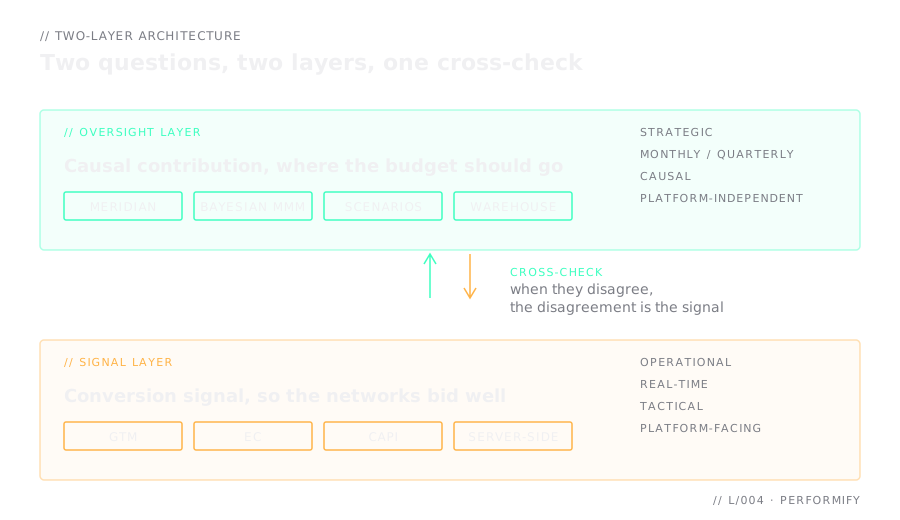
Two questions, two layers
The network signal layer is operational and runs in real time. It answers a tactical question: given the user who just clicked, what conversion did they drive, and how should the bidding algorithm respond? Smart-bidding quality is directly proportional to signal quality. A CAPI feed at 95% Event Match Quality will bid meaningfully better than one at 60%.
The oversight layer is strategic and runs quarterly or monthly. It answers a causal question: of the revenue we earned last quarter, what share was incremental to marketing spend, and where does the next pound produce the most return? Bayesian MMM is the most defensible way to answer this because it quantifies uncertainty and does not depend on any single platform's identity graph.
Both layers are necessary. The networks need the signal. The business needs the oversight.
This article treats both layers as necessary. Some commentators argue that MMM alone is sufficient and platform signal is unimportant. That view ignores the commercial impact of poor smart-bidding on in-flight budget efficiency. Others argue that platform attribution is enough and MMM is academic indulgence. That view ignores how much revenue gets misattributed or invented by platform reports. The position here is that both extremes leave money on the table.
What the networks actually need from you
The practicalities of EC and CAPI implementation (what each recovers, where the ceiling sits, how to order the build) are covered in L/003. This piece assumes that work is in hand and focuses on the larger question of why a clean signal layer on its own is not sufficient.
Google Ads, Meta Ads, TikTok Ads, all the major platforms run their bidding on machine-learning models that predict conversion probability per impression. Those predictions are only as good as the training signal. Starve the model of conversion data and it defaults to broad heuristics, which means worse targeting, higher CPAs, and over-investment in easy traffic that converts without much help.
The practical implication: Enhanced Conversions, Meta CAPI, and equivalent server-side conversion APIs are not cosmetic compliance items. They are how you make the networks spend your budget better. Treating them as optional is equivalent to buying media with worse targeting than your competitors.
Better signal, better bidding. There is no philosophical position that justifies ignoring this.
What the networks cannot tell you
Ad networks are also commercial entities with an obvious interest in attributing revenue to themselves. Greedy attribution, where every platform claims credit for the same conversion, is a feature of the system. Combined attributed revenue across Google, Meta, TikTok and affiliates routinely exceeds actual revenue by 40% to 80%, depending on conversion goal and audience overlap. The networks know this. The reports do not say it.
The networks also cannot see what they did not touch. Organic search, direct traffic, word of mouth, PR, email, all contribute to revenue without appearing in paid platform reports. Smart bidding optimises against what the platform sees, over-investing in easy-to-measure channels and under-investing in channels it cannot observe.
This is not a fixable bug. It is the structural limit of asking the platforms to measure themselves.
The oversight layer
Marketing Mix Modelling is a statistical technique for estimating the causal contribution of each marketing channel to business outcomes, using time-series data that spans multiple channels and non-marketing drivers. Bayesian MMM, as implemented in Google's Meridian framework, quantifies uncertainty in those estimates, which matters because point estimates without confidence intervals are how teams make expensive mistakes.
The output of a well-built MMM is a channel-level contribution breakdown, saturation curves per channel, and scenario plans for budget reallocation. Crucially, none of it depends on platform attribution. MMM sees all spend and all revenue, then infers the causal relationships between them.
L/005 covers the MMM stack in detail. For this piece, the relevant point is that MMM is the only layer that answers the question the networks structurally cannot.
How the layers work together in production
In practice, good measurement runs both layers continuously and uses them to cross-check each other.
The signal layer feeds the networks high-quality conversion data via Enhanced Conversions, CAPI, and server-side event pipelines. Smart bidding uses it to optimise in-flight. Platform reports remain directional, not definitive.
The oversight layer runs monthly or quarterly. It produces channel contribution estimates, saturation curves, and reallocation scenarios. Its output feeds budget decisions, not in-flight bidding.
When the two layers disagree about a channel, the disagreement is itself the signal. If Google Ads reports strong ROAS but MMM shows low incremental contribution, the channel is likely cannibalising organic or brand. If MMM shows strong contribution but platform attribution is weak, the signal layer is leaking and needs work.
Both layers share one dependency: a warehouse that can feed both of them. The signal layer needs reliable, low-latency event data to push to the networks. The oversight layer needs the same warehouse to produce the joined dataset MMM runs on.
Why most teams run only one layer well
Most performance marketing teams are good at one layer and blind to the other.
Teams built around platform operations treat Enhanced Conversions as done once implemented and live inside the ad manager UIs. They trust platform-reported ROAS, miss brand/non-brand cannibalisation, and over-invest in channels with clean attribution regardless of actual contribution.
Teams built around analytics and data science treat MMM as the answer and under-invest in the signal layer. They show up in board meetings with contribution charts but cannot explain a 30% CPA drift, because they stopped feeding the networks quality signal and the bidding algorithms compensated with broader targeting.
Teams that get the best results run both layers, which usually means different people or different mindsets on the same team.
A team that shows strong platform ROAS and no MMM is usually overspending on brand and retargeting. A team that shows strong MMM results and no platform signal quality is usually bleeding budget to worse bidding than their competitors. The pattern of failure is symmetric even though the failure modes look very different.
What good looks like
Good measurement looks like this.
Signal layer: Enhanced Conversions and CAPI running at above 8 of 10 Event Match Quality on the primary conversions, monitored monthly. Server-side event collection on critical pages. Platform-reported ROAS used as an operational metric, not a decision metric.
Oversight layer: MMM refreshed monthly on the last 24 months of data, Bayesian framework with uncertainty quantification, outputs presented as channel contribution with confidence intervals and scenario-planned reallocation.
Governance: quarterly review comparing platform-attributed revenue against MMM-inferred contribution, divergences investigated, budget driven by MMM and not platform ROAS.
L/005 walks through the MMM stack: what Meridian does, how to structure the data, and what a credible output looks like. The two layers are different questions, both deserving proper answers. Most of the performance marketing industry runs one of them badly.